Marker ink separates into different colors on wet paper because most inks are blends of several dyes, and each dye travels a different distance as water moves through the paper. This process, called paper chromatography, works because dyes differ in how strongly they cling to paper fibers versus how easily they dissolve and move with water.
Draw a dot of black marker on a strip of filter paper or paper towel, touch the bottom edge to water, and watch it climb. Within a few minutes, the black dot pulls apart into bands of blue, purple, and sometimes green or pink. The ink was never truly black. It was several dyes mixed together, and the paper and water separated them by the same principle chemists use to identify unknown substances in a lab: chromatography.
This is one of the experiments students in Grades 5 and 6 do themselves in the Evolving program in one of modules.
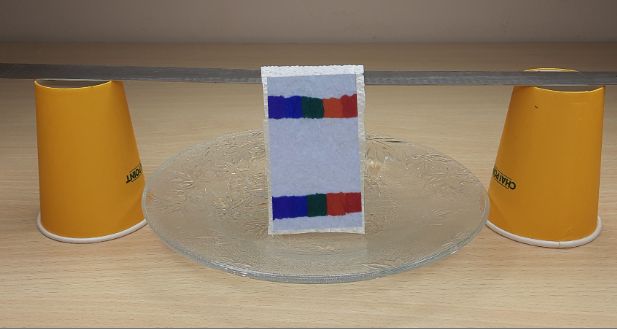
What is chromatography?
Chromatography is a technique for separating the components of a mixture by passing it through a material that interacts with each component differently. In paper chromatography, the mixture is a dot of ink, the moving material is water (the mobile phase), and the paper is the stationary material (the stationary phase) that the mixture moves across. As water travels up the paper by capillary action, it carries the ink’s dyes with it. Each dye has its own balance of solubility in water and attraction to the paper’s cellulose fibers, so the mixture spreads into separate bands instead of moving as one.
Why do some colors travel farther than others?
Colors travel farther when they dissolve more readily in water and cling less tightly to the paper fibers. A dye that is highly soluble and only weakly attracted to cellulose rides along with the water almost the whole way, ending up near the top of the paper. A dye that binds more strongly to the fibers gets left behind closer to the starting dot, even though the same water is moving past it. This is why black marker ink, which is usually a blend of several dyes, unfolds into a ladder of colors rather than staying one solid line. Chemists describe how far each dye travels relative to the water front as its retention factor, or Rf value, and it is consistent enough for a given ink and paper that it can be used to help identify a substance.
How is this used outside a classroom demonstration?
The same separation principle scales up to real analytical chemistry. Forensic scientists use ink chromatography to compare pens used on a document or to help date when a document was written, since ink formulas change over time. Chemists use more advanced forms of the technique, such as gas chromatography and high-performance liquid chromatography, to separate and identify compounds in blood samples, drinking water, and pharmaceuticals. The mechanism is the same one at work on a strip of filter paper: a mixture moves through a stationary material, and the parts that interact with it differently end up in different places. The water itself moves for a different reason, covered in Convection Currents: Why Hot Water Floats on Cold Water.
Why this concept matters in the curriculum
Chromatography gives students a result they can see happen in real time and connect directly to a molecular-level explanation: solubility and surface attraction acting on different substances in different amounts. It is also one of the more direct paths from a kitchen-table experiment to an actual laboratory technique, since the paper chromatography a student runs at home uses the same logic as the instruments used in forensic and pharmaceutical labs. In the Budding program it sits inside the Solutions in Focus module, alongside the Science of Colours module that explains where the separated colors come from.
Frequently Asked Questions
Why does black marker ink separate into other colors?
Most black marker ink is a blend of several dyes rather than a single black compound. When water carries the ink through paper, each dye moves at a different rate based on its solubility and attraction to the paper fibers, so the blend separates into visible bands of color.
What paper works best for a chromatography experiment at home?
Filter paper, coffee filters, and paper towels work well because they are made of loosely packed cellulose fibers that let water travel through steadily by capillary action. Regular printer paper is denser and tends to give faster but less distinct separation.
Does chromatography work with all types of markers?
It works best with water-based markers, since the ink needs to dissolve in water to travel through the paper. Permanent markers use ink designed to resist water and other solvents, so they separate poorly or not at all with a water-based experiment.
Does chromatography work with leaves?
Yes. Crush a green leaf in a little rubbing alcohol instead of water, since leaf pigments do not dissolve in water. The extract separates into green chlorophyll bands and yellow or orange carotenoid bands, which is how the hidden autumn colors of a leaf can be seen while it is still green.
What is an Rf value?
The retention factor, or Rf value, is the distance a dye travels divided by the distance the water travels in the same time. It is a consistent number for a given dye, paper, and solvent, which is why chromatography can help identify unknown substances.
Is paper chromatography the same technique used in forensic labs?
It is the same underlying principle, though forensic and industrial labs typically use more sensitive versions such as thin-layer, gas, or liquid chromatography. All of them separate a mixture by how its components interact differently with a moving and a stationary material.
Our programs are designed to introduce students to advanced concepts like this through hands-on exploration, supported by conceptual understanding.
See what a class looks like