Yes, an online STEM class can be genuinely hands-on, but only when it is built around live experiments the child runs themselves, not pre-recorded videos. In a live session the child does the experiment while an instructor watches and guides in real time. Below is what that looks like in our own classes.
This is the question we hear on almost every trial call. Most parents have already tried a STEM app or two, the kind where a video plays and a quiz pops up at the end, with nothing in the child’s hands. So when they hear the phrase online hands-on STEM program, some doubt is fair. Whether a class is really hands-on comes down to what happens in the session, not the fact that it runs over a screen.
What a parent wrote to us
A few weeks after her son started with us, a parent sent this:
“Enrolled for my son and he is enjoying it thoroughly as not only theory but with practical implementation and discussion. Earlier he was a little hesitant how to complete the experiment but now he is much confident and knows the concepts well. Started loving the actual science.”
This and other parents’ reviews can be read on our Google reviews profile.
One word in it stayed with me: hesitant. Not that he was bored, and not that he was lost. He paused before starting, the way anyone does with something new.
Is it normal for a child to struggle at first?
Yes, and it is usually a good sign. If a child finishes an experiment without a single moment of doubt, it probably was not asking much of them. Real hands-on work means a balloon that will not inflate on the first try, a reading that comes out wrong, a build that tips over. A child who has not done this before will hesitate. I would be more worried if they did not.
That hesitation is where the learning sits, and it is the one thing a recorded video cannot reach. A video cannot see a child staring at their materials, unsure what comes next. A live instructor can, and that is the moment that matters. Instead of handing over the next step, the instructor asks what the child thinks will happen if they change something. It is slower. It is also how a child moves from following instructions to understanding why they work, which is the confidence this parent noticed.
Experiments our students actually build
The photos below come from our own students during live classes. A student built and ran each one at home. None of them are studio setups or stock images. They are experiments done on ordinary kitchen tables and study desks. That is deliberate.

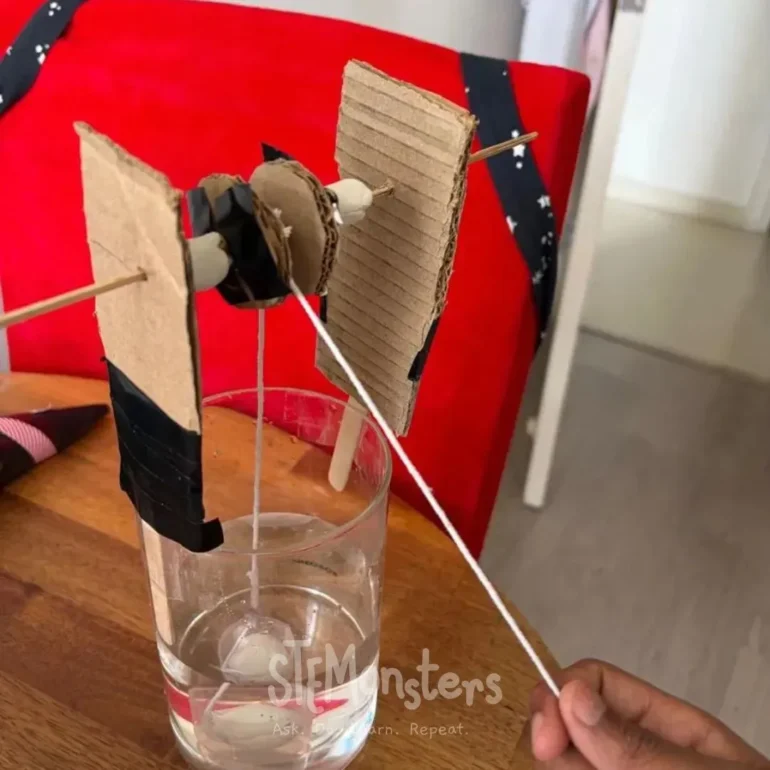
A third child inflated a balloon using baking soda and vinegar, on camera, with the instructor watching each step. Different experiments, same habit: build it, test it, then work out why it did what it did.

What actually happens in a live session?
One concept, one experiment, run by the child while an instructor watches live. Every class pairs a single concept with a single experiment, and the child runs it, not a recording playing to them. When something does not behave the way the textbook promised, we slow down. The better questions almost always come from those moments.
The program runs across four levels, Budding, Evolving, Stellar, and Pioneers, from grade 3 to grade 12. A grade 3 student and a grade 10 student do not get stuck on the same things, so they do not get the same experiment or the same batch. We keep batches small on purpose. An instructor cannot catch that one child’s setup is wrong with twenty others on the call.
From “how do I finish this” to “I enjoy actual science”
What stays with me about that parent’s note is not the praise. It is the change underneath it. At the start, the worry was how to finish the experiment. By the end, the child had come to enjoy the science itself. A video playing correctly does not do that. A child does it, by working through something difficult, asking a question in the middle of it, and seeing a concept hold up because they made it hold up themselves.
That is what every session is for. Not a finished worksheet. A child who reaches for the next experiment without being asked.
Frequently asked questions
Can a child really do hands-on experiments in an online STEM class?
Yes, when the class is built around live, guided experiments rather than pre-recorded instruction. In our after-school program, the child runs the experiment themselves while an instructor watches and talks them through it in real time.
Is it normal for a child to feel unsure the first time they try an experiment?
Yes. Feeling unsure at the start of a new hands-on activity is common, and it usually means the experiment is challenging enough to be worth doing.
What age groups does the hands-on program cover?
STEMonsters runs four age-tiered levels, Budding, Evolving, Stellar, and Pioneers, covering grades 3 to 12, each matched to the concepts and experiment difficulty appropriate for that age.
Does my child need to be supervised during the session?
Every experiment is designed to be safe for a child to run, and instructors are trained to identify issues before they arise.
Can I change batches after my child joins?
Yes, subject to space in the batch you would like to move to.
The best way to know if this fits your child is for them to attend a session live, with our other students. And if they hesitate at the start, that is the sign it is working.
Request a trial session