
Student Question · Evolving Program
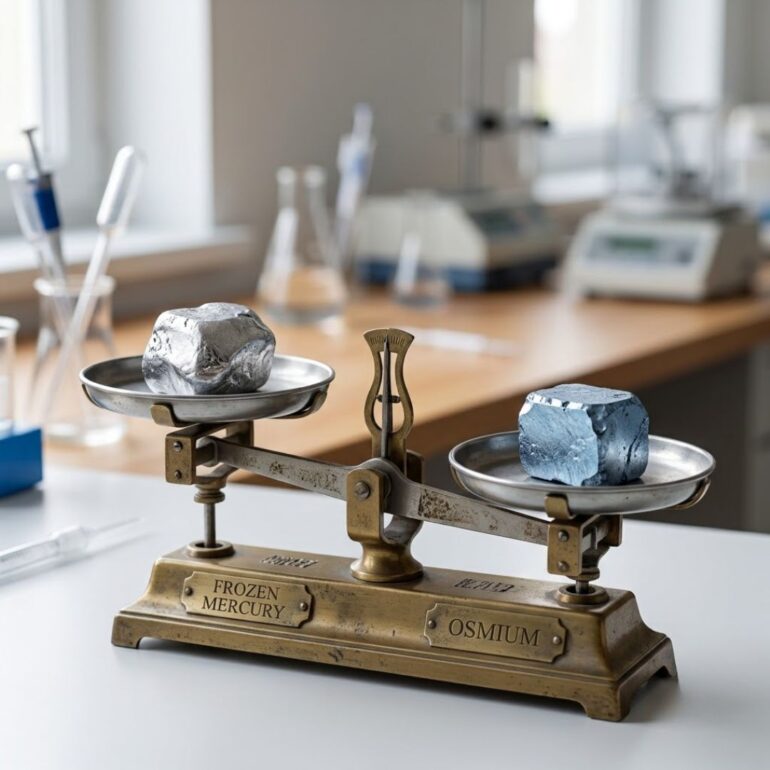
No. Liquid mercury sits at 13.53 g/cc. Freezing raises that by about 3.5%, taking it to roughly 14 g/cc. Osmium, the densest element known, sits at 22.57 g/cc. Osmium also resists compression. Mercury cannot close that gap, even under pressure.
Where This Question Came From
We were covering states of matter in one of our classes when a student combined two prior facts into a new question. We had covered that mercury is the only metal that stays liquid at room temperature, and that despite being a liquid, it is heavier than a block of solid iron. We had also noted that osmium is the densest element. The student’s question followed directly from those two points: most substances densify on freezing, and liquid mercury is already dense, so does freezing push it past osmium? None of us had the figure memorized, so we looked it up after class.
Why Is Liquid Mercury Already This Heavy?
Mercury’s atoms are unusually heavy for their size and pack together tightly, which alone accounts for much of its density. A liter of mercury weighs about 13.53 kilograms, nearly twice what a liter of iron weighs and well past what a liter of lead manages at 11.34 kilograms.
The remaining explanation traces back to relativity. Chemist Peter Schwerdtfeger and others have shown that mercury’s outer electrons move fast enough for their mass to increase, which contracts that outer shell by roughly 20%. Fewer electrons are then available to form the metallic bonds that hold most elements together as solids at room temperature. This is a large part of why mercury’s melting point sits more than 200°C below what its position on the periodic table would predict. Its density and its liquidity are not separate facts; they follow from the same underlying physics.
Does Freezing Actually Make Mercury Denser?
Yes, but only slightly. Most substances pack their atoms closer together on solidifying, which is why solids are typically denser than the liquid form of the same material. Water is a known exception, which is why ice floats. Mercury follows the ordinary pattern. Going from liquid to solid raises its density by about 3.5%, taking it from 13.53 g/cc to roughly 14 g/cc. A liter of frozen mercury weighs perhaps half a kilogram more than a liter of the liquid, which is not enough to change its ranking relative to osmium.
Could Solid Mercury Ever Close the Gap With Osmium?
No. The gap is more resistant to closing than it may initially appear. Even after the 3.5% increase, frozen mercury tops out around 14 g/cc, more than 8 grams per cubic centimeter short of osmium’s 22.57 g/cc. A 2015 study published in Nature, led by Leonid Dubrovinsky, compressed osmium past 770 gigapascals using a nanodiamond anvil cell. For reference, pressure at the center of the Earth is estimated at around 360 gigapascals, so the study exceeded that by more than a factor of two. Osmium retained nearly all of its original crystal structure under this pressure, showing only faint electronic shifts at isolated points.
Why We Value Being Asked Questions Like This
No worksheet prompted this comparison. The student arrived at it by connecting two previously stated facts, which is the kind of reasoning we aim to encourage in every class. Students raise questions like this one in our Evolving and Stellar programs, where they work through the numbers themselves rather than accepting a density chart as given. Inquiry-based, hands-on instruction produces exactly this outcome: students extend beyond the lesson plan and raise questions we have to research ourselves.
Frequently Asked Questions
Is mercury denser than iron?
Yes. Liquid mercury sits at about 13.53 g/cc. Solid iron is around 7.87 g/cc. Mercury is nearly twice as dense.
What is the densest element at room temperature?
Osmium, at about 22.57 g/cc. It is the densest of all naturally occurring elements.
Does mercury expand or contract when it freezes?
It contracts, as most substances do. This raises its density by roughly 3.5% once it solidifies.
At what temperature does mercury freeze?
Around minus 39 degrees Celsius, which is why it is encountered only as a liquid under ordinary conditions.
Is osmium hard to compress?
Extremely. A 2015 study in Nature compressed it past 770 gigapascals, more than double the pressure at Earth’s core, and it retained nearly all of its structure.
Questions like this come up often in our Evolving and Stellar classes.
See what a class looks like →


